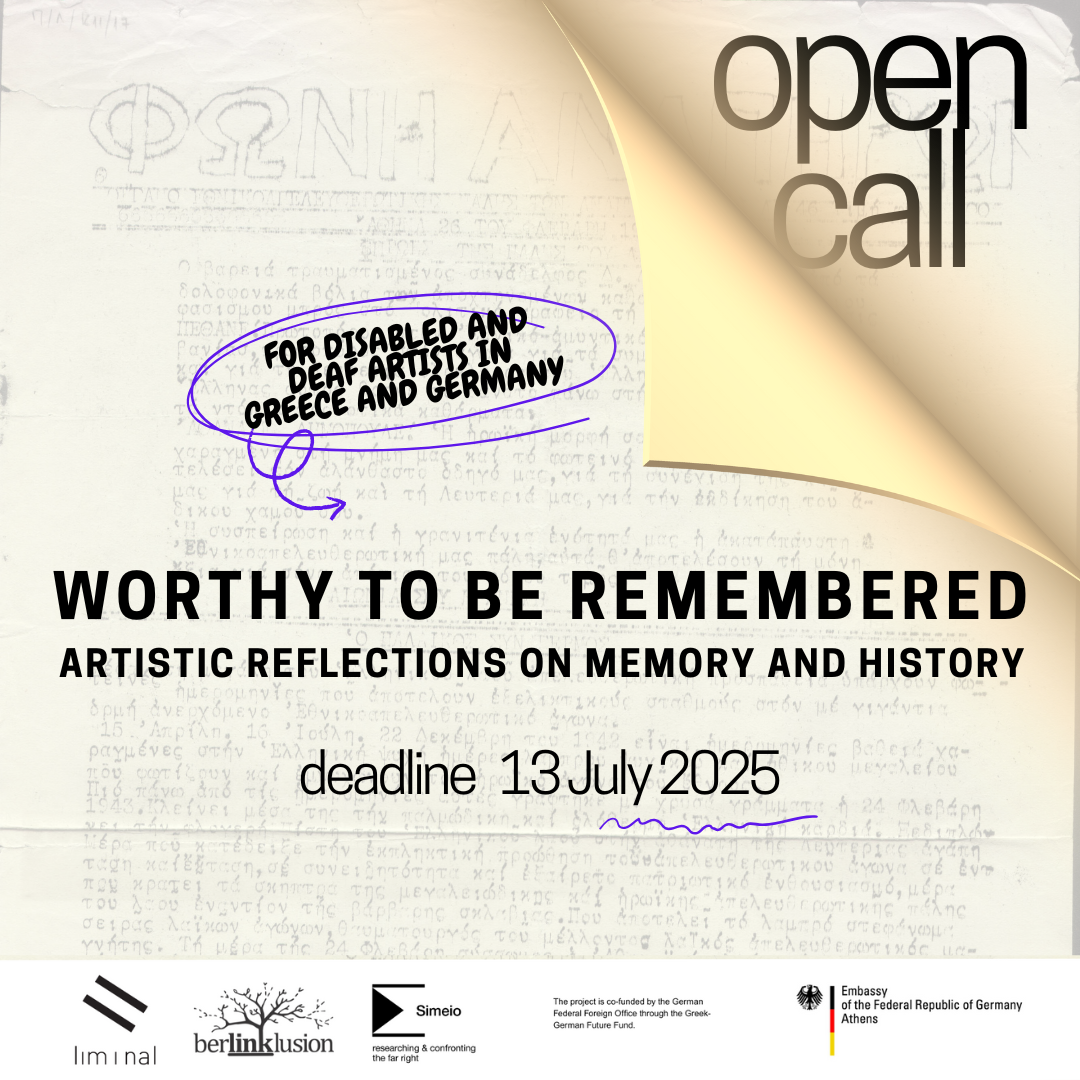
Worthy to be Remembered
A Mini-Residency for Artistic Reflections on Memory and History
Berlin | Athens, 2025
About Worthy to be Remembered
“Worthy to be Remembered: Artistic Reflections on Memory and History” is led by liminal (Greece) in collaboration with Berlinklusion (Germany), Simeio: Researching & Confronting the Far Right (Greece), and historian Iason Chandrinos (Greece).
It is based on the history findings of the previous liminal project “Worthy to be Remembered: Honouring Disabled Victims of Nazi Persecution in Greece and Germany” funded by the Greek-German Fund for the Future, which shed light on the overlooked history of disabled individuals persecuted under the Nazi regime in both Greece and Germany. The project contributed to historical research by highlighting the under recognized resistance of disabled individuals within the Greek National Liberation Front (EAM) during the Occupation (1941–1944) and exposing the brutal violence they endured—culminating in the blockade of Athens hospitals by local collaborators on November 30, 1943. The research led to the publication of two accessible articles in German and Greek, available freely online here.
Building on this foundation, “Worthy to be Remembered: Artistic Reflections on Memory and History” seeks to disseminate the key findings of the research, and honor the memory of disabled individuals while confronting the erasure of the disability movement’s heritage.
We were interested in how artistic practice can be a vehicle for remembrance, recognition, and critical reflection—shedding light on the pivotal role of disabled individuals in the Greek Resistance, and connecting historical injustices to contemporary forms of ableism and exclusion. By drawing parallels between past and present forms of discrimination, we sought to promote a counter-narrative rooted in inclusivity, transnational awareness, and solidarity.
About the Residency
The residency began by launching an open call, and selecting four disabled and Deaf artists—two based in Greece and two in Germany—who were commissioned and supported through an online mini-residency program spread over 5 months to create accessible artworks inspired by these historical narratives and their contemporary resonances. The artists were encouraged to apply from a variety of disciplines, however we were also encouraging visual artists to apply, as this is a severely underfunded and under supported field for disabled artists in both Germany and Greece.
Each selected artist received a stipend of €2,000 to experiment, explore, and develop new, or further develop existing artworks. With the support of Berlinklusion and liminal, the artists were encouraged to incorporate accessibility into the design of their work, enabling their work to be more accessible and enjoyable for a wider audience.
The selected artists began the residency by gathering together online to meet each other and participate in a two-day, relaxed online workshop. These sessions introduced them to the historical context and key concepts of accessibility in performing and visual arts practices and included:
- An Introduction to the Research and Historical Context by historian Dr. Iasonas Chandrinos
- An Introduction to Ableist Theory and Far-Right Ideology by Ioanna Meitani (Simeio | Signal: Researching and Confronting the Far Right)
- An Introduction to Embedding Access into Visual Art by Kirstin Broussard
- An Introduction to Embedding Access into Performing Art with liminal
- A Presentation “From Research to Artistic Practice” with Dirk Sorge
From July to November, the artists continued working independently, at their own pace and in their chosen environments, with flexible scheduling. The two artists in Berlin traveled to Greece to conduct site visits and develop on-site artistic responses. Support in networking with the local art scenes in Athens and Berlin was provided to all the participants.
Between September and November, participants received personalized, one-on-one online mentoring from members of liminal and Berlinklusion, supporting the development of their artistic projects.
At the end of the residency period in November, the artists presented their work-in-progress, shared insights into their creative processes, and reflected on the themes explored during the program in a final online event held in English, German Sign Language and Greek Sign Language.
Accessibility
Access was integrated into the curatorial process from the beginning, with the design of a low-barrier open call and application process. Key aspects of the open call were the outreach work to both German and Greece disability arts communities, including providing information about the program in sign language, as well as the low level of bureaucracy required for applicants.
We designed the residency as a low commitment engagement for the artists, and sought to strike a balance of activities to bring the artists together either to obtain new knowledge or share their work, but to also provide enough space and time for them to develop their work independently. Our meetings were staged online, in a relaxed format with many scheduled and ad-hoc breaks, and recorded in case anyone had to leave. While we had asked artists to commit to the initial workshop and final online event, artists were free to work at their own pace and in their preferred location. There was no expectation for the artists to have a completed artwork at the end of the 5 months.
Participants could also determine and pay for their own access costs related to the production of their work. Additional accessibility support was provided or offered, such as translation between Greek and English/German, and Interpretation in German Sign Language (DGS) and Greek Sign Language (GSL), audio description support, Greek and German SDH (Subtitles for the Deaf and Hard of Hearing). In Greece, it was also possible to access an accessible physical workspace, subject to prior agreement with the organizers.
About the Artists
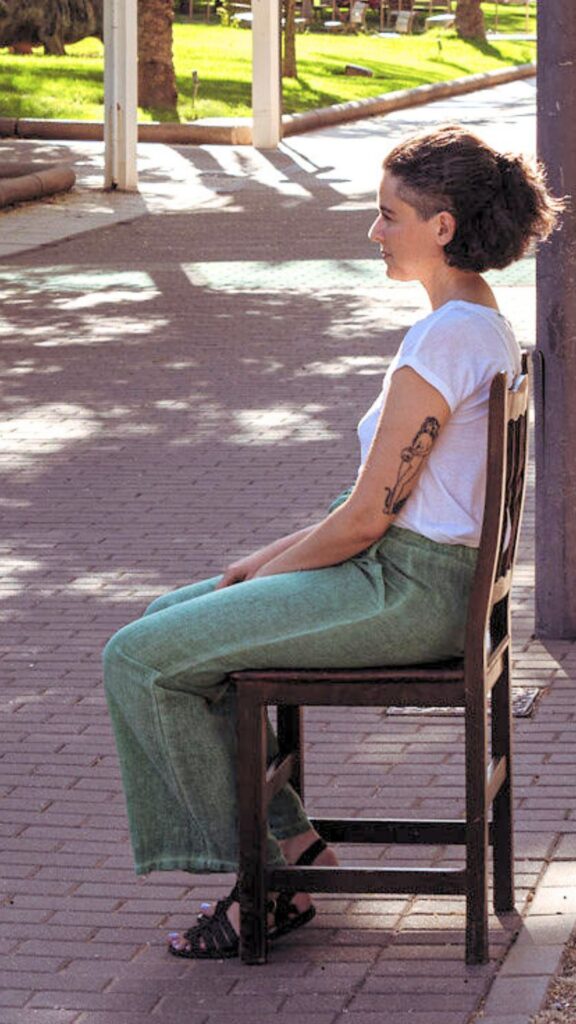
Vicky Dimitropoulou
A deaf/Hard of Hearing performer and cultural manager based in Greece and Spain. Her work combines storytelling, performance, and social research, with a focus on the social issues faced by the communities she collaborates with.
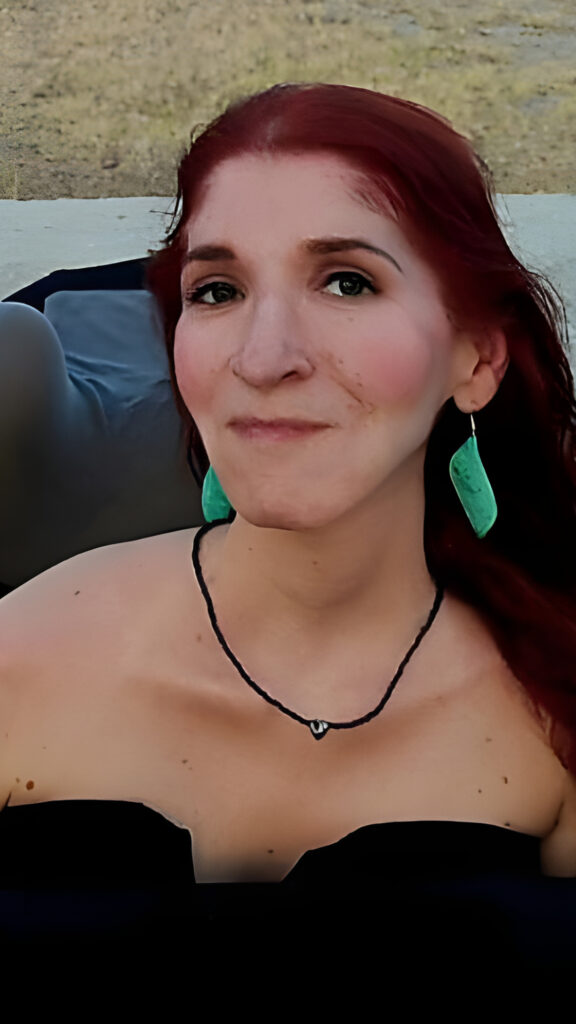
Eva Lampara
A visual artist, performer and graphic designer based in Athens. She paints with her mouth and uses the stillness of the body as a means of expression, redefining notions of identity and diversity. Her work challenges social stereotypes and advocates for a more inclusive understanding of disability.
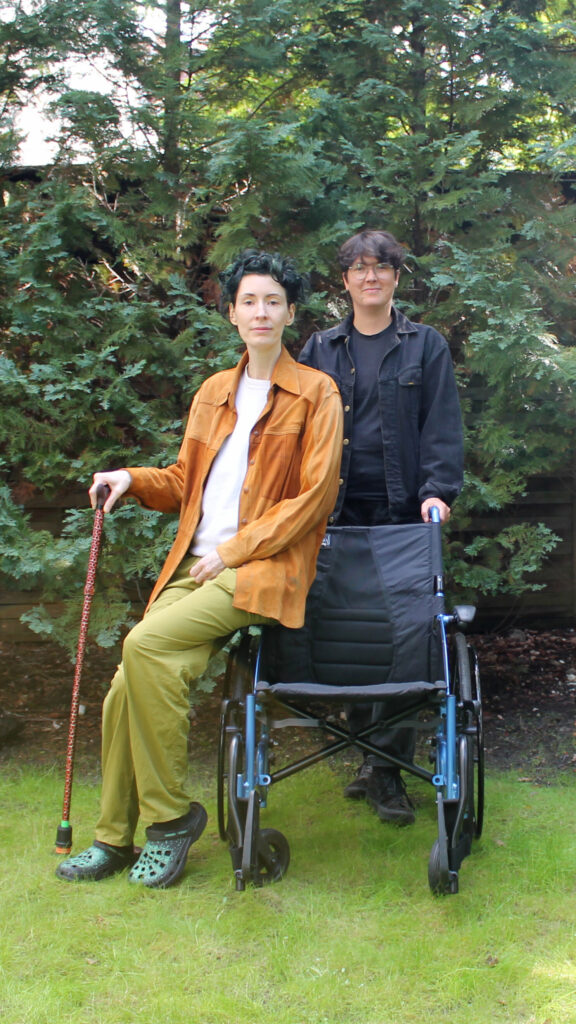
RC Taube & Kit Blamire
RC Taube is a queer disabled artist based in Berlin. Their recent work engages with language, sound, and clay as primary media. Kit Blamire is a queer disabled filmmaker, writer and riso printmaker whose work focuses on sickness as anti-capitalism and on documenting pandemic grief. They seek to explore how fascist ideologies shape society’s understanding of disability and how resistance emerges in our everyday lives and collective movements.
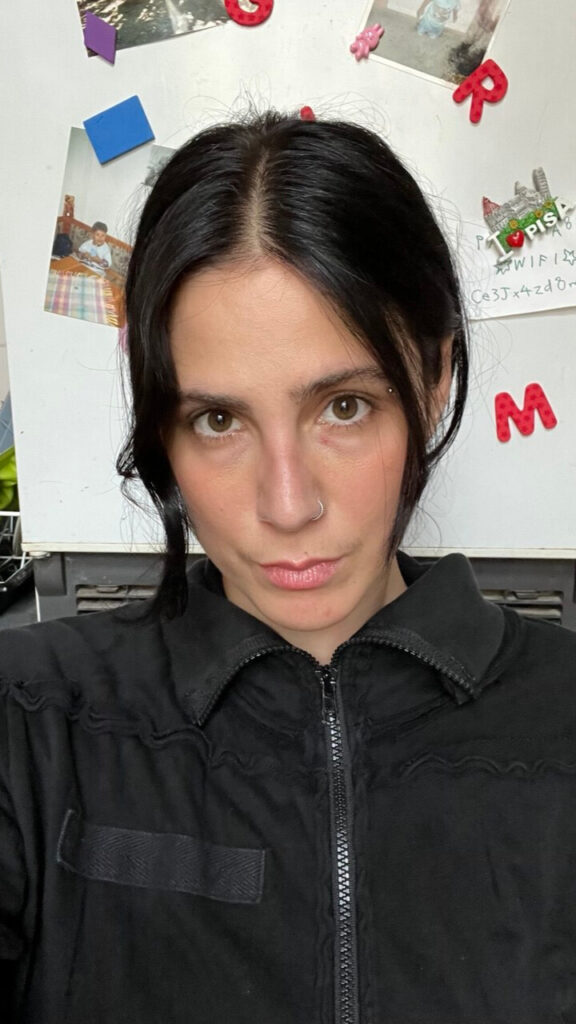
Almitra Pyritidis
Almitra Pyritidis is an interdisciplinary artist based in Berlin. She uses body-based practices like movement research, dance, and performance to explore how sickness, memory, and identity – both personal and collective – intersect and shape our experiences.
The project is co-funded by the German Federal Foreign Office through the Greek-German Future Fund.